
Bitcoin’s ratio to silver is something worth looking at, if you’re into assets that compound your financial independence: the both represent an asset class outside of direct institutional control. You can self-store the both and transact the both with relative ease through local brokers. Bitcoin/silver ratio is a bit like the more commonly used Bitcoin/gold ratio, but with more leverage, as silver tends to follow gold’s lead with more volatility due to less availability in primary production. This is my strategy to trade this ratio.
I use the weekly candlesticks, because this timeframe seems to give the clearest picture.
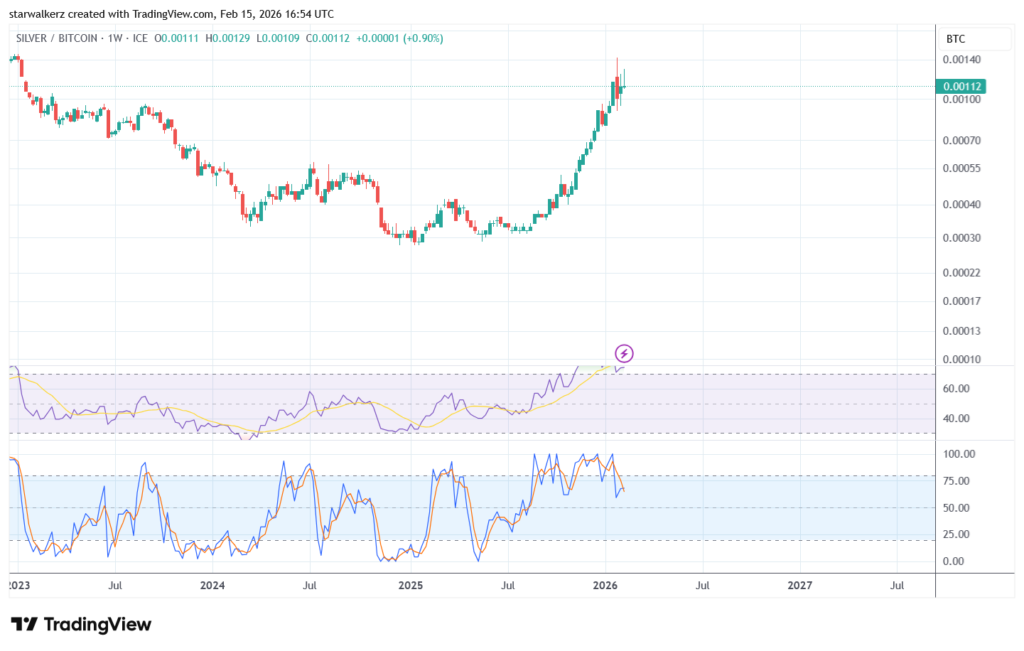
Silver’s value in Bitcoin seems to be topping out with the weekly RSI forming a clear topping pattern above 80 points and the stochastic turning bearish. We can see an exhaustion candlestick pattern complete with a gravestone doji completing the week ending to Valentine’s Day 2026.
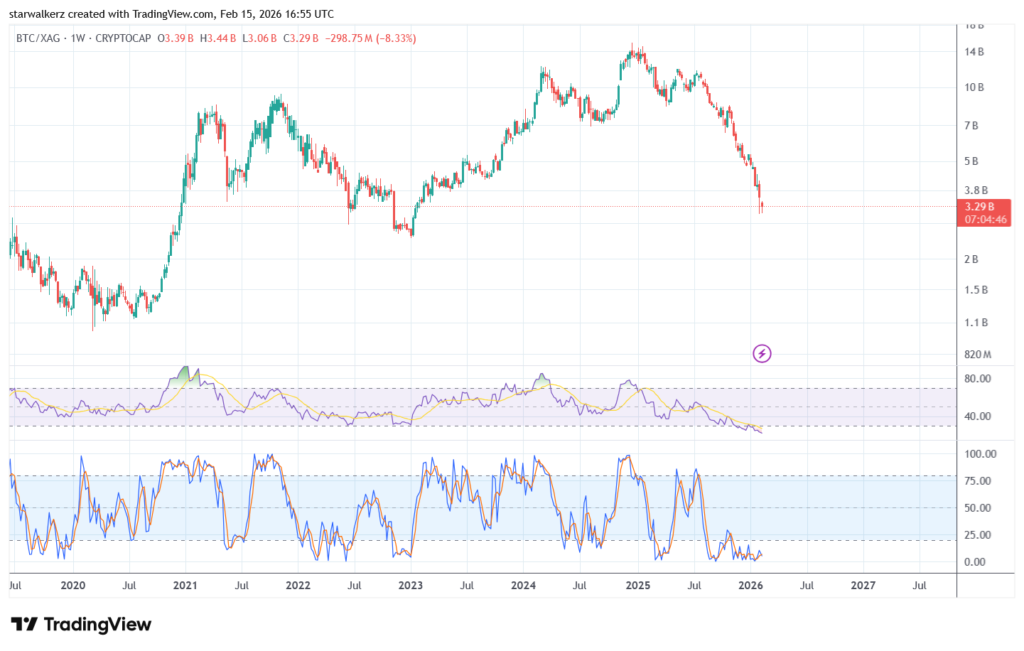
On the flipside, Bitcoin’s market cap measured in silver seems to be forming a capitulation bottom with a clear downward hockey stick and exhaustion candles in the first two weeks of February 2026, oversold RSI and Stochastic below the lower band indicating bullish momentum returning in the near future.
The weekly timeframe indicates a clear market reversal happening in favor of Bitcoin within the next few months, possibly during H1/Q2 of 2026 and a full exit from the bearmarket during Q3 2026 against silver.
Taking into account Bitcoin’s tendency to follow a sinewave pattern of head and shoulders followed with the same in inverse, or the Wyckoff pattern, against broader commodities markets including silver, bullmarkets and bearmarkets would therefore be around half a cycle length in terms of the Bitcoin’s four-year halving cycle. In simple terms, this would mean a roughly 12 to 18 months long bullmarket if nothing significantly changes about the market fundamentals in Bitcoin or silver.
Bitcoin and the crypto market in general tend to follow the global liquidity cycles, where the U.S. Treasuries are a significant component. Therefore we may speculate that if the Federal Reserve initiates quantitative easing or the Treasury department finds a way to circulate new Treasury bills into the market to satisfy a speculatively increased federal spending despite an ongoing Western consumer market recession in 2026 and simultaneous China crypto bans and sluggish European institutional crypto market adoption, Bitcoin and crypto would stand to benefit out of this scenario. The move would in this environment, in my view, be volatile and hype-driven catching most people off-guard, lifting the entire crypto market along with it, but due to high retail participation result in a prolonged bearmarket afterwards.
The market would only recover after the commodities markets have restarted the industrial cycle from the bottom-up, crypto and tokenization representing the next wave in financialization. This would happen somewhere in the 2030’s.
Good luck and Godspeed!