
History has been made. For the first time ever, there’s a commercial spaceflight training course recognized by the European & U.S. higher education systems, as well as all of the Western space agencies including CNES, ESA and NASA! I attended the very first opening webinar outlining the course structure and curriculum for the foundational module, The Human Spaceflight Certificate. I found about this program when I were casually browsing social media and I met the founder, so we vibed and here we are.
The Human Spaceflight Certificate is a PhD -level program aimed for applicants holding at least a MSc or equivalent and at least three years of work experience in a relevant technical field and a certificate of good health. The course contains modules that are physically and psychologically demanding, but disability-friendly. It is a foundational training program consisting of four modules preparing the student for further studies in the fields of spaceflight, space technology engineering, space mission planning and operations, and of course, to become a real-life astronaut!
The course is organized by The Spaceflight Institute, in close collaboration with ISAE-Supaéro, CNES, ESA and NASA. There are many industrial partners as well, but I will blog about the full details when they’re published by the institute. I haven’t signed an NDA, but this is for respect and good manners.
The Human Spaceflight Certificate is an annually recurring course program with a rigorous and transparent multi-stage selection process meeting with the French École Superieure quality standards.
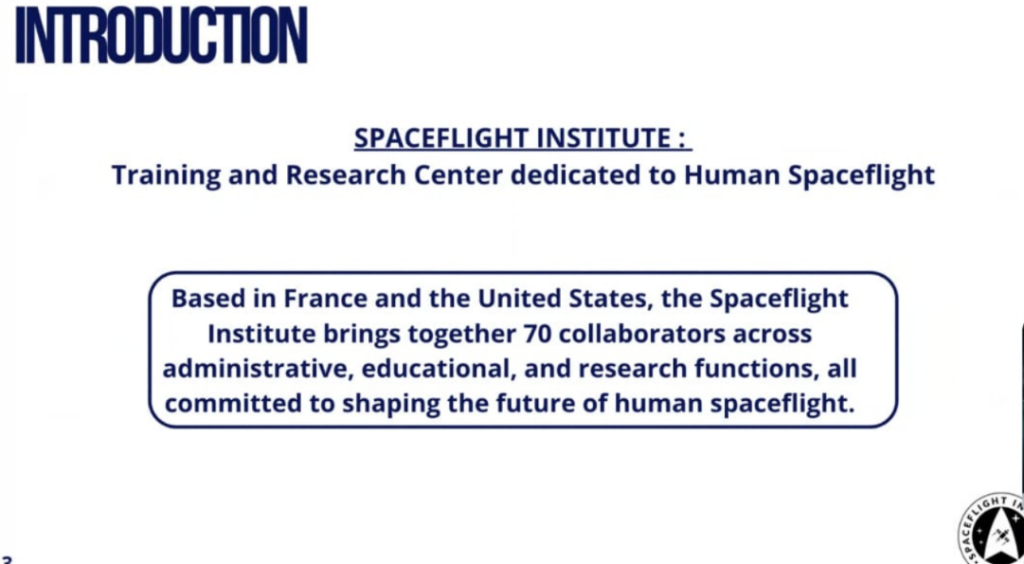
The Human Spaceflight Certificate is the first course module on the path of an aspiring astronaut aiming for full professional qualifications. The course qualifies for ECTS credits and is admissible for PhD -level studies in all U.S. universities. Obviously the students at ISAE-Supaéro may also use the course towards their degree programs as well.
The astronaut may choose between two paths: Commercial astronaut training and Institutional astronaut training. The Spaceflight Institute is preparing to eventually offer the qualifying students the full training schedule for the both options.
The advanced astronaut training modules will at least in the near future be partly organized in the U.S. but hopefully one day, as European space capabilities and infrastructure develop there might be an option to fully become an astronaut on European soil. This is still speculative, but it would be nice in my opinion. We could mutually assist each other between the European and the U.S. civilian space programs.
The Spaceflight Institute is open TODAY for applicants from the WHOLE WORLD. EU/U.S. sanctions lists apply, of course because of course they do. Otherwise, and this is for real, no matter who you are and where you come from – let me tell you something – you can become an astronaut!
I will likely attend after completing my MSc. I currently study energy technology. Obviously, energy + space = energy in space. Makes sense, right?