
How Digital Subcultures Form, Fracture, and What We Can Do About It
I. The Pattern That Repeats
In August 2024, thousands of young Kenyans took to the streets to protest the government’s Finance Bill, using TikTok, X, and Instagram to coordinate a leaderless, decentralized uprising that forced the government to withdraw the legislation. Within months, the movement that had begun with a specific, achievable goal—rejecting a tax bill—had fractured. Some protesters pivoted to constructive political engagement. Others adopted the slogan #RutoMustGo, shifting from policy reform to regime change. A smaller fringe, as happens in such moments, began to explore more radical paths.
This is not an isolated story. It is a pattern that repeats across movements, platforms, and generations.
The #MeToo movement, which began as a necessary reckoning with sexual violence, spawned both meaningful institutional reform and a fringe that treated every ambiguous interaction as an act of predation. The Body Positivity movement, which started as a liberating rejection of thin-centric beauty standards, eventually gave rise to both a “SkinnyTok” backlash and extreme mukbang content that turned self-destruction into entertainment. The Arab Spring, which promised democratic transformation, produced both fledgling democracies and the rise of ISIS.
This pattern—the K-shaped recovery of social movements—is not accidental. It is structural. And understanding its architecture is the first step toward preventing the radicalization it produces.
II. The Spin-Out: How Radical Identities Form
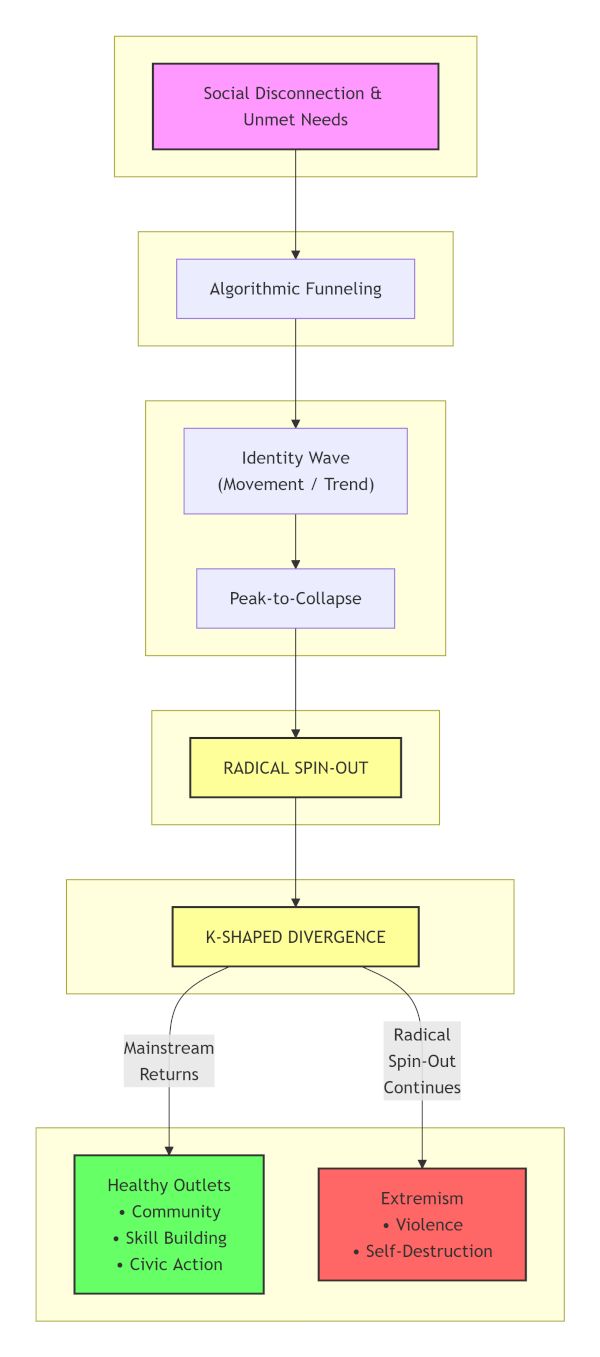
Every major identity-driven social movement follows a predictable lifecycle: emergence, escalation, peak, plateau or collapse, and—critically—spin-out. During the peak-to-collapse phase, a radical wing separates itself from the main identity, forming a more extreme, dogmatic, and often violent offshoot.
This spin-out is not driven by the movement’s core figures. It is driven by the periphery—the followers who have invested their identity most heavily in the movement’s promises. When the movement fails to achieve all its objectives (and no social movement achieves all its objectives), these followers do not abandon the identity. They intensify it. They reject the mainstream movement as “compromised” or “co-opted” and position themselves as the only authentic continuation of the original cause.
In the manosphere, this dynamic is visible everywhere. The ecosystem begins with seemingly harmless content: fitness advice, dating tips, self-improvement strategies. Algorithms, optimizing for engagement, progressively guide young men toward more extreme content. The manosphere “is not a marginal subculture; it is a dynamic and profitable system of misogynistic radicalisation” that “targets boys at their most vulnerable, exploits their insecurities, and converts loneliness into rage, grievance into identity, and misogyny into ideological violence”. The radical spin-off—incels, blackpill accelerationists—represents the periphery intensifying the ideology beyond what even the central figures advocate.
In the Body Positivity movement, the same pattern unfolded. The movement’s peak was followed by a cultural reversion: the rise of “SkinnyTok,” a space filled with extreme dieting, calorie restriction, and thinspiration content. Meanwhile, extreme mukbang content emerged, featuring influencers “performatively overeating extreme quantities of junk foods”, creating a grotesque mirror of the movement’s original promises.
In the Gen Z protest movements across Africa and the emerging markets, the pattern is still unfolding. Kenya’s 2024 protests were leaderless, digitally native, and issue-based. But the same structural pressures that produce spin-outs elsewhere are already visible: arrests, police violence, and repression of the central figures have increased significantly in the region and around the world since the initial Gen Z protests. Copycat protests have already taken place in the region, most notable regional example being the protest associated with the Tanzanian 2025 general election. The question is not whether a radical spin-out will occur—it is whether constructive outlets can be provided before it does.
III. The Peripheral Defender: Why Followers Are More Extreme Than Leaders
The radical spin-out is not driven by the movement’s core. It is driven by the periphery. This is the “sycophant paradox”: the most extreme, dogmatic, and aggressive defenders of any identity are almost never the central figures. They are the followers who derive their status from proximity to the core—and who must constantly prove their loyalty through performance.
This pattern is visible across every subculture we have examined:
In the manosphere: The most extreme voices—those who advocate violence, who embrace the “black pill” worldview of biological determinism and hopelessness, who celebrate acts of terror—are not the central influencers. They are the followers, the forum users, the ones who have invested their identity most heavily in the ideology. Self-identified incels show severe mental health burdens, including elevated depression, anxiety, loneliness, suicidal ideation, autism spectrum traits, and disengagement from education and employment. The radicalization pathway is driven by “mental health distress and ideological adherence” operating bidirectionally.
In identity politics: The most dogmatic “woke” purists are not the movement’s founders or most prominent voices. They are the peripheral activists who must constantly prove their commitment through ever-escalating purity tests. The South African activist who condemns Finnish cultural symbols as “appropriation” without any historical connection to the Ndebele is not representing a central intellectual tradition—she is performing loyalty to a globalized moral framework from the geographic periphery.

In religious extremism: The most vicious anti-LGBTQ campaigners are not in Western centers of evangelical power. They are in Uganda, Kenya, and other peripheral locations where imported ideologies must be intensified to prove authenticity. The same logic applies to the most extreme Islamist voices, which often emerge not from traditional centers of Islamic scholarship but from diaspora communities and peripheral regions where identity must be constantly performed.
IV. The Eight Impulses
Beneath the surface diversity of these subcultures, the psychological drivers are remarkably consistent. Our analysis identifies eight core impulses that radicalization exploits:
| Impulse | Description | Affected Subcultures |
|---|---|---|
| Lack of Belonging | Loneliness, isolation, desire to be seen and accepted | Incels, MGTOW, Active Clubs |
| Status Anxiety | Panic over social standing, seeking relative superiority | Red Pill, Performative Streamers, White Knights |
| Appearance/Body Dissatisfaction | Extreme insecurity over appearance or physical capacity | Lookmaxxing, Bonesmashing, Mukbang |
| Lack of Existential Validation | Craving for attention, even through destruction | Rappiotubettaja, Accelerationism |
| Moral Superiority | Self-affirmation through playing the role of the “righteous” | Woke Dogmatists, White Knights, Christian Nationalism |
| Cognitive Closure | Fear of a complex world, craving for simple explanations | All ideological subcultures |
| Identity Crisis | Deep insecurity about “who I am” | LGBTQ+ Purists, Neo-Paganism, Racists |
| Economic Despair | Threat to material survival | African Jihadism, Gen Z protest movements |
Loneliness is not merely a personal problem—it is a political one. Research has found that “the feeling of not belonging and being failed by the current system can make people receptive to extremist ideologies”. Loneliness has been recognized by the World Health Organization as a global public health concern, with effects on mortality equal to smoking 15 cigarettes a day. Philosopher Hannah Arendt described loneliness as “the common ground for terror” and “the essence of totalitarian government”—not just a lack of social connections, but “the feeling of not belonging in the world at all”.
V. The Algorithmic Funnel
The radicalization process is not organic—it is engineered. Algorithms, optimizing for engagement, progressively guide users from harmless content to extreme ideologies.
A young man searching for fitness advice is quickly categorized by the algorithm. “The system links interest in ‘male strength’ almost automatically with reactionary worldviews,” according to a 2026 study. What begins as a search for self-improvement becomes a funnel into the manosphere. “The ‘cultural touch point’ content often acts as the top of the funnel for young boys”.
The same mechanism operates across other subcultures. TikTok’s algorithm, which has been shown to suggest eating disorder content to new teen accounts within minutes, progressively guides users toward more extreme content. The platform’s design—infinite scroll, algorithmic recommendations, engagement optimization—creates a radicalization machine that operates at scale.
“Ein Algorithmus ist kein Pädagoge, sondern ein Geschäftsmodell. Das funktioniert über Zuspitzung und Radikalisierung, weil die Leute so länger auf der Plattform bleiben” — “An algorithm is not a pedagogue, but a business model. It works through escalation and radicalization, because that keeps people on the platform longer”.
VI. The K-Shaped Divergence
At the critical turning point—the moment when a movement fails to achieve its full objectives—the path divides.
The mainstream returns to constructiveness. Participants pivot to civic engagement, policy advocacy, community building. In Kenya, some Gen Z protesters have begun engaging with electoral systems, voter registration, and collective advocacy. In the manosphere, a minority of participants exit the ecosystem through therapy, mentorship, and community connection. Research on ex-incels shows that leaving requires “a journey in and out of inceldom” that is possible through sustained intervention.
The radical spin-out continues to extremism. The peripheral defenders, unable to accept the movement’s limitations, intensify their commitment. They reject the mainstream as “compromised.” They adopt more extreme positions. They may eventually embrace violence, self-destruction, or both.
This divergence is not inevitable. It is shaped by the availability of constructive outlets—alternatives that provide belonging, meaning, and agency without requiring radicalization.
VII. Healthy Outlets: The Architecture of Prevention
The key to preventing radicalization is not simply to suppress extreme speech or increase surveillance. It is to build a parallel infrastructure that competes with extremism for appeal.
Our analysis identifies seven categories of healthy outlets:
| Outlet | Description | Corresponding Impulses |
|---|---|---|
| Genuine Community Building | Non-adversarial groups based on shared interests, goals, or values | Lack of Belonging, Identity Crisis |
| Skill Development | Building self-esteem through learning transferable skills | Status Anxiety, Lack of Existential Validation |
| Functional Movement & Physical Practice | Shifting body optimization from aesthetics to function and health | Appearance/Body Dissatisfaction |
| Creative & Volunteer Expression | Expressing self and anger through non-violent means | Lack of Existential Validation, Moral Superiority |
| Civic Participation | Channeling political energy into institutionalized channels | Economic Despair, Systemic Distrust |
| Psychological Education | Learning to identify and regulate impulses and cognitive distortions | Cognitive Closure, Identity Crisis |
| Cross-Group Dialogue | Transcending identity boundaries, understanding complexity | Moral Superiority, Cognitive Closure |
Community-based interventions have been shown to be effective. Programs that combine “youth mentorship and leadership training” with “empathy development” and “resilience building” can “prevent violent radicalization”. Sport and organized activities function as “non-stigmatising, low-threshold tools, allowing natural dialogue, routine, and a healthier self-narrative to develop”.
The European Union’s approach to preventing violent extremism focuses on “investing in local leadership, community cohesion, and inclusive participation” to “address the underlying conditions that can lead to radicalisation”. In Finland, projects like Sawian work with youth “at higher risk of social exclusion” through activities in their native languages, focusing on “topics related to gang formation and radicalisation”.
VIII. The Logic of Prevention
If radicalization follows a predictable pattern, prevention must follow a predictable logic.
At the individual level: Media literacy education, emotional regulation skills, and community connection can reduce vulnerability. Young men need to understand how algorithms funnel them toward extreme content. They need alternative models of masculinity that do not depend on dominance or resentment.
At the community level: Constructive alternative subcultures must be available. Programs that provide “mentorship and leadership training”, “psychological support and counseling”, and “education, employment, and pro-social activities” can offer viable alternatives to radicalization.
At the platform level: Algorithm transparency, content diversity, and de-radicalization recommendations can reduce the “capture surface” for extreme content. Platforms must acknowledge that “algorithms are not neutral conduits—they are designed to maximize engagement, and radicalization maximizes engagement”.
At the societal level: Economic empowerment, political participation channels, and social trust rebuilding address the deep roots of radicalization. In Kenya, youth voter apathy has been at its highest levels since the 2010 constitution. Reversing this requires “civic and voter education, voter registration, and collective advocacy”.
IX. The Uncomfortable Truth
The radical spin-out is not a failure of individuals. It is a structural feature of how identity movements operate in the digital age. When a movement peaks and cannot deliver on its promises, the periphery—those who have invested their identity most heavily—does not abandon the cause. It intensifies it.
The incel who embraces the black pill, the mukbang creator who performs self-destruction, the activist who moves from protest to violence—these are not anomalies. They are the logical endpoint of a system that offers identity, belonging, and meaning through radicalization, and offers no constructive alternatives.
The uncomfortable truth is that radicalization is a solution to a problem. It solves loneliness by providing belonging. It solves status anxiety by providing a clear hierarchy. It solves identity crisis by providing a fixed, certain identity. It solves cognitive closure by providing simple explanations for complex problems.
The only way to prevent radicalization is to provide better solutions—solutions that do not require hatred, violence, or self-destruction. This means building communities that offer genuine belonging without demanding ideological purity. It means creating pathways to status that do not require dominance over others. It means providing meaning that does not depend on the destruction of an imagined enemy.
This is not easy. It requires investment in community infrastructure, mental health support, and alternative models of identity. It requires platform accountability and algorithmic transparency. It requires a fundamental rethinking of how we understand and respond to the crises of belonging and meaning that define our era.
But the alternative—more radicalization, more violence, more self-destruction—is not acceptable.
X. Conclusion: The Pattern Is Not Inevitable
The K-shaped recovery is a pattern, not a prophecy. It describes what happens when movements fail to provide constructive outlets for the energy they generate. But the pattern can be interrupted.
In Kenya, some Gen Z protesters are pivoting to voter registration and civic education. In the manosphere, some young men are exiting through therapy and community connection. In the Body Positivity movement, some advocates are shifting toward “body neutrality” and health-focused approaches.
These are not exceptions. They are evidence that the pattern can be broken—if we build the infrastructure to break it.
The radical spin-out is not inevitable. It is a product of neglect: neglect of the lonely, the anxious, the status-insecure, the identity-crisis-stricken. When we fail to provide constructive outlets, extremism fills the void.
When we build community, we build alternatives to radicalization. When we provide skill development, we provide alternatives to status anxiety. When we offer genuine belonging, we offer alternatives to ideological capture.
The architecture of radicalization is well-understood. The question is whether we have the will to build the architecture of prevention.
References
- “How loneliness and isolation can fuel anti-democratic attitudes,” RTE Brainstorm, January 2026
- “Involuntary Celibacy in the Digital Age: a Critical Narrative Review of the Incel Phenomenon, Mental Health Burden, Ideological Pathways, and Public Health Implications,” Current Psychiatry Reports, June 2026
- “Wie Social Media junge Männer in die Radikalisierung treibt,” rbb24, February 2026
- “Shrinking ideals: Why the resurgence of ‘skinny’ and trends like ‘SkinnyTok’ is more than just a concerning trend,” Orri, 2025
- “Opinion: Body positivity losing its lustre on social media,” Winnipeg Free Press, June 2025
- “Gen Z’s digital activism is changing the game in Kenya—but to win, they need to do more,” Africa at LSE, July 2025
- “Generation Z Revolts and Implications on Political Change in Kenya: Lessons Learned,” Daystar University, 2025
- “Incels and psychotherapy: Experiences, attitudes, and resistance to mental-health interventions,” Cronfa Swansea University, 2025
- “The Evolution of the Incel Subculture,” Psychology Today, August 2025
- “The Body-Positivity Movement Is Over,” The Atlantic, June 2025
- “Contentious Interation in Ultima Generazione (Last Generation). A Preliminary Analysis on Radicalization and Spin-off Movements,” SocietàMutamentoPolitica, 2024
- “Beyond Toxic” study on algorithmic radicalization, International Central Institute for Youth and Educational Television (IZI) and MaLisa Foundation, 2026
- “From Football Fields to Safe Spaces: Building Youth Resilience in Kenya,” GCERF, December 2025
- “Sport and organised activities in rehabilitation and reintegration: experiences from Norway,” European Commission, May 2026
- “EU funded project Sawian helps prevent youth crime in Finland,” European Commission, November 2025