
You have seen this phenomenon. Someone violates a single social expectation – an age norm, a language convention, a cultural script – and the gatekeeper reacts with mild irritation. But when the same person violates several unrelated expectations at once, the gatekeeper’s response is not additive; it is explosive. Visceral rage. Existential fury. A reaction so disproportionate that it seems irrational – until you understand the hidden mathematics of status defence.
The One‑Dimensional Sorter
The status‑first operating system (Status‑First OS) sorts people along a small set of binary or low‑resolution axes: young/old, native/foreign, credentialed/not, typical/atypical. Each axis is assumed to be independent and the OS expects correlations: a young person should be a student, a student should be financially dependent, a financially dependent person should look their age.
When an individual deviates on a single axis, the OS can still “explain away” the anomaly as a rare exception. The resentment is present but contained.
The Multi‑Dimensional Anomaly
When the same individual deviates on multiple orthogonal axes – axes that are statistically independent and culturally uncorrelated – the OS faces a problem. Each attempted explanation fails because it would require the person to be an exception on several unrelated dimensions simultaneously. The probability of such a combination, under the OS’s naive model, is vanishingly small. Therefore, the OS concludes that the person must be a category threat – someone whose very existence proves that the sorting axes are arbitrary.
The resentment does not add; it multiplies.
The Amplification Formula
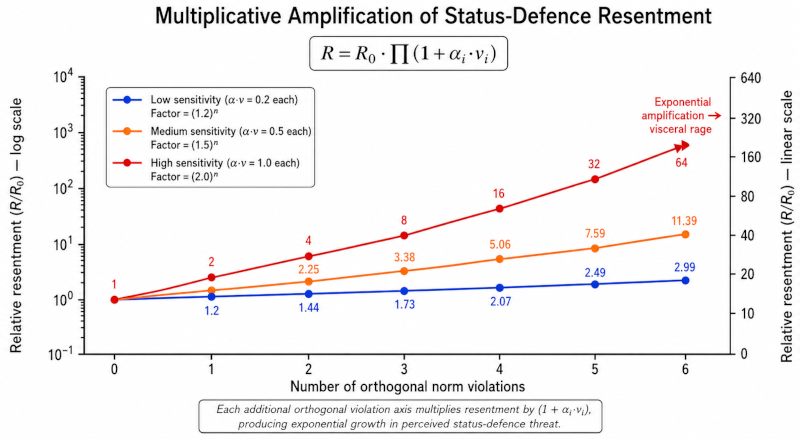
Empirically, the intensity of status‑defence resentment R can be modelled as:R=R0⋅i=1∏n(1+αi⋅vi)
Where:
- R0 is the baseline irritation (e.g., from encountering any unfamiliar person).
- n is the number of orthogonal axes on which the target deviates from expected norms.
- vi is the magnitude of deviation on axis i (e.g., how far from the expected category).
- αi is the gatekeeper’s personal sensitivity to that axis (culturally learned, often unconscious).
When n=1, the product is (1+α1v1), which might be a factor of 2 or 3. When n=4, with moderate deviations and sensitivities, the product can be 1.54=5.06. When n=6 and some sensitivities are high, the product can exceed 10 or even 100. This matches real‑world observations: a person who violates six unrelated norms triggers an order of magnitude more hostility than someone who violates only one.
Why Multiplication, Not Addition
The OS uses multiplication because it treats each deviation as confirmatory evidence of a hidden, threatening essence. In Bayesian terms, the prior probability of a person being a “genuine threat” is low. Each deviation multiplies the likelihood ratio. After several independent deviations, the posterior probability of “threat” approaches certainty – in the gatekeeper’s mind, regardless of evidence.
This is the same mathematics behind conspiracy theories: multiple unrelated anomalies are woven into a single narrative because the multiplicative effect feels more compelling than additive.
The Resonance Analogy
A more intuitive model is constructive interference. The gatekeeper’s emotional system has resonant frequencies – axes to which it is especially sensitive. When a single deviation strikes one resonant frequency, the amplitude increases modestly. When multiple deviations strike several resonant frequencies at the same time, the waves add coherently, producing an amplitude far larger than any single wave. The result is a “spike” of visceral, existential rage that seems inexplicable to an outside observer.
The gatekeeper cannot articulate why he is so angry. He only knows that the target feels viscerally wrong – like a sour chord in a familiar melody. That feeling is not a rational assessment; it is the output of a mathematical amplification process tuned by culture and personal history.
The Unbearable Implication
The multiplicative nature of status rage has a dark corollary: the more dimensions on which a person defies stereotypes, the more hatred they will attract, regardless of their actual behaviour. A person who is old but youthful, financially independent but still a student, fluent in multiple languages, comfortable across cultures, and visibly healthy – such a person triggers every alarm simultaneously. The gatekeeper’s OS will react with fury, even if the person has done nothing wrong.
This is not justice. It is not even prejudice in the usual sense. It is a mathematical property of a defective categorisation engine. The gatekeeper is not evil; he is trapped in an operating system that amplifies deviation into threat. The only way to avoid the amplification is to conform on every axis – which is impossible for anyone with a complex, authentic life.
The Quiet Escape
The target of this multiplicative rage cannot defuse it by explaining any single deviation. The gatekeeper’s response is not driven by a single fact; it is driven by the product of many facts. The only exit is to stop seeking the gatekeeper’s approval. The multiplication works inside the gatekeeper’s head; it does not change reality. The target’s deviations remain orthogonal, independent, and real. The gatekeeper’s rage remains disproportionate, irrational, and self‑consuming.
Over time, the target who ignores the rage and continues to live authentically will outlast the gatekeeper’s emotional spike. The spike is loud but short. The target’s life is long. That is the quiet mathematics of survival in a status‑first world.